El referéndum sobre la introducción del DNI electrónico en Suiza el 28 de septiembre me cerró las puertas. En el último minuto, la mayoría de los votantes suizos votó “sí” a su introducción en 2026. En 2021, habían votado “no” por una amplia mayoría. Los burócratas no se rindieron y simplemente continuaron con el desarrollo. También necesitas un smartphone. Tienes que descargar una aplicación. El Partido Libertario Suizo se opuso vehementemente. Yo también.
El furor por “Smart” comenzó con un coche pequeño. Un ambicioso novato suizo de los fabricantes del Swatch. Ahora hay relojes inteligentes fabricados en China, tenemos smartphones y vivimos en “Smart Cities” los ciudades inteligentes. Tu casa también se está volviendo inteligente.
Intenta argumentar en contra de eso. Intenta ganar puntos con estupideces. No funcionará. La “i”, que significa “inteligente”. iPhone, iWatch, iToilet. O, también de moda, la “e”: la “billetera electrónica”, el “e-Timmermans” y la “e-U” con su comando a “e-V”.
Es genial, porque no quieres conocer lo opuesto a toda esta belleza: no quieres un “teléfono básico”, no, no un “fonotonto”. No quieres vivir en una Ciudad Tonta ni tener una Identidad Tonta, ¿verdad? ¿La ID-T: la identificación tonta?
¿Rebelión contra la tecnocracia?
¿Iniciar un contramovimiento? ¿Hacer algo contra la ideología “inteligente”, contra la mercantilización de la inteligencia, contra la grotescamente insensata electrificación de la sociedad? Ni hablar. La generación joven. La generación digital, la generación inteligente, los listillos, quieren un dispositivo inteligente, compatible con la tecnología para todo: calzoncillos inteligentes con un rastreador de género integrado y un medidor electrónico de vello púbico para la verificación automática de edad. Esta generación desea desesperadamente que el gobierno los tenga agarrados por los huevos. Porque no tienen nada que ocultar, ¿verdad? Y nada que ganar, ¿verdad?
Dios, estoy tan frustrado con el resultado de ese referéndum en el país alpino. Tenía tantas esperanzas de que votaran “no”. Así podría seguir diciendo: “¿Ven por qué la UE le tiene miedo a la democracia directa por referéndum?”.
Si rechazo todas estas nuevas tonterías ahora, ya no me permitirán trabajar en el Reino Unido (y la verdad es que no quiero), y Ursula tampoco me dejará participar en su sociedad. ¿De verdad quiero eso? ¿Una sociedad liderada por gente inteligente? ¿Con jóvenes líderes globales envejecidos? ¿Los jóvenes líderes globales con huevo? ¡Dios mío, me siento tan impotente ante la aplanadora maquinaria propagandística de la burocracia! Mi voz no llega a nadie; soy una voz que clama en el desierto. Solo tengo unos pocos seguidores encantadores en X, que me regaló el algoritmo, animándome a pasar aún más tiempo en la plataforma digital.
Inteligente. Y yo que creía que ya lo era. Mi rebelión también es virtual. No una rebelión analógica, manual. Tiene que ser una Rebelión Inteligente, al menos ahora. De libertarios digitales inteligentes, artificiales y virtuales, equipados con una identificación electrónica, precursora de la identificación de IA, o en el mundo digital: la identificación KI.
Estoy desfasado, soy cosa del pasado. Un dinosaurio que ya no se adapta a los tiempos. Pero, ¡maldita sea!, sigo pagando en efectivo, y acabo de dejar caer mi iPhone al agua. Por un momento, fui inaccesible por teléfono, indetectable, ingobernable. ¡Qué liberación! Sin pitidos, sin melodías, sin nervios. Sonrío. Con la “o” de o-lé!.
¡Y hurra, “o”, soy especial: un detenedor del tiempo! ¡Un o’timer!
The referendum on the introduction of the E-ID in Switzerland on September 28th closed the door for me. At the last minute, the majority of Swiss voters voted “yes” to its introduction in 2026. In 2021, they had voted “no” by a large majority. The bureaucrats didn’t let it go and simply continued development. You also need a smartphone for it. You have to download an “app.” The Swiss Libertarian Party was vehemently opposed. So was I.
The Smart hype started with a small car. An ambitious Swiss novice from the makers of the Swatch. Now there are smartwatches made in China, we have smartphones, and we’re living in smart cities. Your house is becoming smart too.
Try arguing against that. Try scoring points with stupidity. It won’t work. The “i,” which stands for “intelligent.” iPhone, iWatch, iToilet. Or, also trendy, the “e”: the “e-wallet,” the “e-Timmermans,” and the “e-U” with its soon compulsory “e-V.”
It’s brilliant, because you don’t want to know the opposite of all this beauty: you don’t want a “dumbphone,” no, you don’t want to live in a Dumb City or have a Dumb Identity, do you? The D-ID: the dumb ID?
Rebellion against the technocracy?
Start a countermovement? Do something against the “smart” ideology, against the commoditization of intelligence, against the grotesquely insane forced electrification of society? Not a chance. The young generation. The e-, i-, and smart generation, the Smarties, want a Smart, i-, and e-for everything: i-underpants with a built-in i+ gender tracker and an e-pubic hair meter for automatic e-age verification. This generation desperately wants the government to have them by the balls. Because they have nothing to hide, right? And nothing to gain, right?
God, I’m so frustrated about the outcome of that referendum in the Alpine country. I was so hoping they’d vote “nein/non/no”, so I could keep saying: “do you see why the EU is afraid of direct referendum democracy?“
If I refuse all this new nonsense now, I wouldn’t be allowed to work in the UK anymore (I don’t really want to, anyway), and empress Ursula won’t let me participate in “her” society anymore either. Do I really want that? A society led by Smart People? With aging Young Global Leaders? The e-i-YGLs?
Good heavens, I feel so powerless against the steamroller propaganda machine of bureaucracy. My voice has no reach; I’m a voice crying freedom in the wilderness. With only a few lovely young female followers (YFF) on X, handed to me by the algorithm, encouraging me to spend even more time on the e-platform and to seduce me to have me verified.
Smart. And I thought I already was. My rebellion is also virtual. Not an analogue, manual rebellion. It has to be a Smart digital e-Rebellion now, at least. Of smart, artificial, virtual e-Libertarians, equipped with an e-ID, which is the precursor to the AI-ID, or, in Flatlandish: the KI-ID.
I’m passé, a thing of the past. A dinosaur that no longer keeps up with the times. But damn it, I still pay using cash, and I just dropped my iPhone in the water. Thus, for a moment, I was unphoneable, untraceable, ungovernable. What a liberation! No beeps, no tunes, no jitters. I grin. With the “o” for off-the-grid..
And hooray, “o,” I’m special: I’m a time-stopper. An o’-timer.
Het referendum over de invoering van de E-ID in Zwitserland op 28 september deed voor mij de deur dicht. Op het nippertje zei de meerderheid van de Zwitserse stemmers “ja” voor de invoering ervan in 2026. In 2021 hadden ze nog met grote meerderheid “nee” gezegd. De bureaucraten lieten het er niet bij zitten en gingen gewoon door met de ontwikkeling. Je moet er ook een smartphone voor hebben. Je moet een “app” laden. De Zwitserse Libertäre Partei was er mordicus tegen. Ik ook.
De Smart hype begon met een klein autootje. Een ambitieus Zwitsers groentje van de makers van de Swatch. Inmiddels bestaan er Smart-watches made in China, hebben we Smart-phones en gaan we in Smart-cities wonen. Ook je huis wordt Smart.
Probeer daar maar iets tegen in te brengen. Probeer maar eens met domheid te scoren. Gaat niet. De ‘i’, die staat voor “intelligent”. iPhone, iWatch, iToiletpot. Of ook trendy, de “e”: de “e-wallet”, de “e-Timmermans” en de “e-U” met haar gebod tot “e-V “
Het is geniaal, want het tegenovergestelde van al dit moois wil je niet kennen: je wilt geen “Dumbphone”, neen, geen “Domfoon”. Je wilt toch ook niet in een Domme Stad wonen of een Domme Identiteit hebben. De D-ID: de domme ID?
Rebellie tegen de technocratie?
Een tegenbeweging beginnen? Iets doen tegen de “smart”-ideologie, tegen het vermarkten van intelligentie, tegen de groteske dolgedraaide elektrificatie van de samenleving? Geen enkele kans. De jonge generatie. De e-, i– en smart-generatie, de Smarties, wil graag een Smart, i en e voor alles, een i-onderbroek met ingebouwde i+-gendertracker en e-schaamhaarmeter voor de automatische e-leeftijdsverificatie. Die generatie wil heel graag dat de overheid hen bij de ballen heeft. Want niks te verbergen toch? En ook niks te makken toch?
God, wat ben ik gefrustreerd over de uitkomst van dat referendum in het Alpenlandje. Ik had nog zo gehoopt dat ze net “nein/non/no” zouden stemmen. Zodat ik kon blijven beweren: ”zie je wel waarom de EU bang is voor directe referendumsdemocratie?”
Als ik al dit nieuw gedoe nu ga weigeren, dan mag ik in het VK niet meer werken (wil ik eigenlijk ook niet), dan mag ik van Ursula ook niet meer aan haar samenleving deelnemen. Wil ik dat eigenlijk? Een samenleving met Smart People aan het hoofd? Met voor hun tijd verouderende Young Global Leaders? De ei-YGL’s?
Guttegut, wat voel ik me onmachtig tegen de stoomwals-propagandamachinerie van de bureaucratie. Mijn stem heeft geen reach, ik ben de roepende in de woestijn. Met slechts enkele lieftallige volgsters op X die ik van het algoritme krijg toegeschoven, zodat ik aangemoedigd word om nog meer tijd op het e-platform door te brengen.
Smart. En ik dacht nog wel dat ik dat al was. Mijn rebellie is ook al virtueel. Geen analoge, handmatige rebellie. Het moet nu minstens een Smart Rebellion zijn. Van smarte, kunstmatige, virtuele e-Libertariërs, voorzien van een e-ID, die de voorloper is van de AI-ID of in het Platlands dan: de KI-ID.
Ik ben passé, verleden tijd. Een dinosauriër die niet meer met z’n tijd meegaat. Maar verdikkeme, ik betaal nog steeds contant en ik heb mijn iPhone pardoes in het water laten vallen. Ik was eventjes on-foonbaar, on-vindbaar, on-regeerbaar. Wat een bevrijding! Geen piepjes, geen deuntjes, geen bibbertjes. Ik grijns. Met de “o” van on-deugend.
En hoera, “o”, ik ben toch bijzonder: een tijdstopper. Een o’-timer.
First published in Libertair Perspectief (Dutch) on June 19, 2025
Author: Edwin J.F. Delsing
“Sovereigns” are in the news with surprising frequency. Here and there, people who claim to be sovereign are arrested and held in prison. But the repression of sovereign ideology only seems to exacerbate the phenomenon. The Dutch Counterterrorst Autority (NCTV) warns of a threat to the democratic rule of law, and the Public Prosecutor seems to be the willing helper. They see “sovereign” ideology as a threat to the state from within. This is exciting because there is a new kind of martyr and a new kind of oppressor. But “sovereigns” are merely the visible exponents, perhaps the extremes, of a much broader emancipation movement, which also includes libertarianism.
As gatekeeper of the democratic rule of law, the NCTV must primarily counter the movements that are chipping away at the very foundations of all the authorities. But rebellion against those in power is a natural social phenomenon, as are the attempts by those in power to allow only controlled changes in those positions. And what movement is more threatening to the guardians of the rule of law than precisely those who ignore what is being ostracized from the plush seats? The reaction of the extreme elements of the state to the extreme elements of an emancipation movement, sets in motion a self-reinforcing mechanism. And is libertarianism, with its claim that man is free and independent, included in this emancipation?
The Sovereign Individual
The book “The Sovereign Individual” by James Dale Davidson and Lord William Rees-Mogg (1997) is an important source for placing the phenomenon in historical context. Their work proves prophetic in several respects:
“The cybereconomy, rather than China, could well be the greatest economic phenomenon of the next thirty years.“
“As the bandwidth revolution unfolds, it will draw people increasingly into the borderless virtual world of online communities and cybercommerce, a world with enough graphic density to become the metaverse.”
“Now the advent of the Information Age implies another revolution in the character of money. As cybercommerce begins, it will inevitably lead to cybermoney… A crucial part of this change will come about because of the effect of information on liberating the holders of wealth from expropriation through inflation. This new digital form of money…will consist of encrypted sequences of multihundred-digit prime numbers. Unique, anonymous, and verifiable, this money will accommodate the largest transactions. It will also be divisible into the tiniest fraction of value. It will be tradable at a keystroke in a multitrillion-dollar wholesale market without borders.”
Note: Satoshi Nakamoto’s Bitcoin whitepaper was only published in 2008…
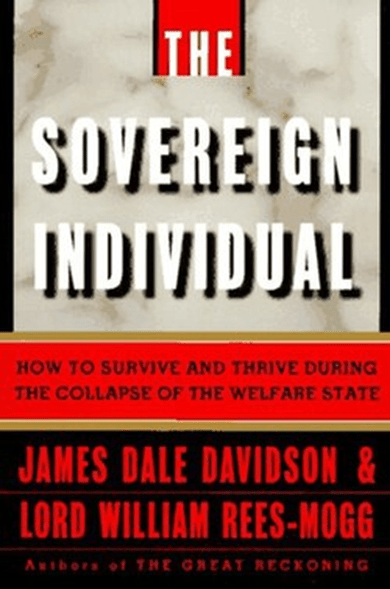
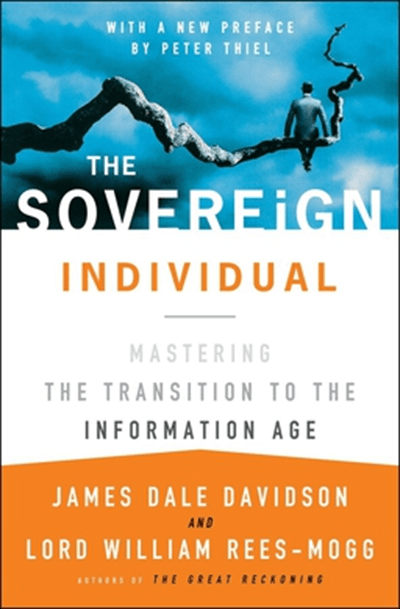
Change of the subtitle
Particularly exciting – for Libertarians – is the change in the subtitle of this book. Originally published in 1997 by Simon & Schuster Inc., the subtitle was “How to survive and thrive during the collapse of the Welfare State.”
In 1999 however, the book was reprinted and given a new subtitle: “Mastering the Transition to the Information Age”.
You don’t have to be a conspiracy theorist to speculate about the reason for this change. The publisher likely found the attack on the social-democratic welfare state a bit too provocative. While the social-democratic ideal, the welfare state, still seems sacrosanct, we’re seeing the term “welfare state” slowly disappear from public vocabulary. So why rub salt on the wound? The concept of the welfare state seems to have been replaced by the concept of the rule of law. The (democratic?) rule of law is something completely different from the social-democratic welfare state. While a libertarian can still legitimately claim to oppose the democratic welfare state, it’s somewhat more problematic if you speak out wholeheartedly against the rule of law. You’re then quickly considered a criminal.
A transition to a repressive form of government?
You will find a very interesting prediction in the book about the transition from the welfare state to a repressive form of government based on legalistic principles: “Lacking their usual scope to tax and inflate, governments, even in traditionally civil countries, will turn nasty. As income tax becomes uncollectable, older and more arbitrary methods of exaction will resurface. The ultimate form of withholding tax—de facto or even overt hostage-taking—will be introduced by governments desperate to prevent wealth from escaping beyond their reach. Unlucky individuals will find themselves singled out and held to ransom in an almost medieval fashion. Businesses that offer services that facilitate the realization of autonomy by individuals will be subject to infiltration, sabotage, and disruption. Arbitrary forfeiture of property, already commonplace in the United States, where it occurs five thousand times a week, will become even more pervasive. Governments will violate human rights, censor the free flow of information, sabotage useful technologies, and worse.” (Translation: “Deprived of their usual means of taxing and collecting, governments, even in traditionally civilized countries, will become dirty. As income taxes become uncollectible, older and more arbitrary methods of collection will reappear. The ultimate form of withholding taxation—de facto or even open hostage-taking—will be implemented by governments desperate to prevent wealth from slipping beyond their grasp. Unlucky individuals will be singled out and held hostage in an almost medieval manner. Businesses offering services that facilitate individual autonomy will be subject to infiltration, sabotage, and disruption. Arbitrary asset confiscation, already commonplace in the United States, where it occurs five thousand times a week, will become even more widespread. Governments will violate human rights, censor the free flow of information, sabotage useful technologies, and worse.”) You could say it’s out of the frying pan into the fire. We don’t consider hostage-taking, punishment before a legally valid conviction, to be constitutional, but it has now become a reality.
Disgusting
The dystopia of a government going to extremes of injustice is not fortune-telling, but the prediction is gradually coming true. Last week (June 10, 2025), the Minister of Justice and Security and Bilderberg participant David van Weel (VVD) proudly tweeted:
English translation:
“Cash payments over 3.000 Euro for goods will be forbidden. And from November 2026 on, we can, thanks to EU-regulation, confiscate criminal assets even without a conviction. Thus we hit criminals where it hurts: at their money.”
“Confiscating criminal assets even without a conviction“: that’s exactly the same as “arbitrary forfeiture of property.” That’s as disgusting as Health minister Hugo de Jonge’s statement about the unvaccinated people: “We know where they live.” Those Ministers have lost their moral compass. Apparently, the democratic rule of law no longer exists in the Netherlands. The liberal finance minister is essentially saying that if government evasion is labeled as criminal ideology, my assets can simply be confiscated without a presumption of innocence, without a judge being involved. Let alone that I would declare myself sovereign or audibly express the suspicion that judges are also biased toward the government! Imagine if I resisted arrest! Criminal. Money lost, house lost, car lost. Everything confiscated. That’s too much power for the hunters.
The somewhat self-satisfied government statement also states:
“In the coming years, the Public Prosecution Service wants to seize more assets.”
This is the PURPOSE of the Public Prosecution Service. The Public Prosecution Service, in collaboration with the IR (FIOD) bloodhounds, will hunt down suspected criminals head-on, waiting like panting puppies for their reward: the heart of the criminalized. New laws seem to be designed to generate more criminals: restrictions on cash payments, combating “disinformation,” and criminalizing dissidents. Supporting this, NCTV reports are being issued that identify threats to the rule of law: people who declare themselves sovereign. This explains why four Frisian “sovereigns” were arrested on June 11th…
Another “incident”: at the end of 2024, eight “radical sovereigns” were arrested on suspicion by the Public Prosecution Service of participating in a terrorist organization. Journalist Erik van de Beek extensively covered this in his article “Hunting Sovereigns” in De Andere Krant on January 19, 2025.
How can the Libertarian Party counteract this?
We can counteract this by spreading our libertarian ideology. We advocate for a drastic reduction in the power of the government apparatus and its influence on society.
Rather than a threat to an established order, we view “sovereignty” as a process of emancipation, of the citizen’s emancipation from the state. In libertarianism, there are no laws that prohibit living without a government. The government may not make it impossible for people to live independently. In a libertarian society, there is absolutely nothing wrong with living out your sovereign ideology. Everyone has their own way. We have long advocated for an individual right to opt out of majority decisions.
Do we then elevate ourselves above the law? No, but we do elevate our principles. Rational moral principles truly do stand above the law of the Kingdom of the Netherlands. John Locke already believed that laws are always subordinate to Reason. Few will disagree with Locke on this point, because laws and governments are, in principle, designed to protect freedom. If it is the government that goes against reason and takes away freedoms, such as punishment before conviction or the introduction of a maximum limit on cash payments, then resistance is called for. Not only because we experience this as a moral duty, but because we must protect our freedom ourselves if the government no longer does so. We can then replace that government with something that fulfills its task better. We can do this, among other things, through political channels. There is, therefore, a very good reason to maintain a libertarian political party. Again, the libertarian principles are:
Mutual respect for (self-)ownership and the Non-Aggression Principle.
It is a recipe for a lasting, peaceful society. If the exponents of an unreasonable and exploitative government now seek to challenge these principles, they will pick a fight with the emancipating citizen and generate resistance themselves. They can never win that fight.
The rise of the sovereign individual.
Davidson and Rees-Mogg state: “The end of an era is often a period of intense corruption. With the loss of cohesion in the old system, social ethics disappear, creating a breeding ground for people in powerful positions to combine public goals with their own amoral activities” (p. 337).
According to the authors, it is precisely current technological developments that make it easier for citizens to escape the shackles of citizenship. The Netherlands is well on its way to becoming a fertile breeding ground for people achieving the transition to individual sovereignty: liberation from coercion, the constraints of unreasonable laws, and hostage-taking.
“The Information Revolution will liberate individuals as never before […] As human transactions increasingly occur in the parallel universe of the cybereconomy, and outside the confines of government regulation, the individual’s relationship to the state will be irrevocably altered.”



 IALP Newsletter