
Why the State Will Lose the Confrontation
First published in Libertair Perspectief (Dutch) on June 19, 2025
Author: Edwin J.F. Delsing
“Sovereigns” are in the news with surprising frequency. Here and there, people who claim to be sovereign are arrested and held in prison. But the repression of sovereign ideology only seems to exacerbate the phenomenon. The Dutch Counterterrorst Autority (NCTV) warns of a threat to the democratic rule of law, and the Public Prosecutor seems to be the willing helper. They see “sovereign” ideology as a threat to the state from within. This is exciting because there is a new kind of martyr and a new kind of oppressor. But “sovereigns” are merely the visible exponents, perhaps the extremes, of a much broader emancipation movement, which also includes libertarianism.
As gatekeeper of the democratic rule of law, the NCTV must primarily counter the movements that are chipping away at the very foundations of all the authorities. But rebellion against those in power is a natural social phenomenon, as are the attempts by those in power to allow only controlled changes in those positions. And what movement is more threatening to the guardians of the rule of law than precisely those who ignore what is being ostracized from the plush seats? The reaction of the extreme elements of the state to the extreme elements of an emancipation movement, sets in motion a self-reinforcing mechanism. And is libertarianism, with its claim that man is free and independent, included in this emancipation?
The Sovereign Individual
The book “The Sovereign Individual” by James Dale Davidson and Lord William Rees-Mogg (1997) is an important source for placing the phenomenon in historical context. Their work proves prophetic in several respects:
“The cybereconomy, rather than China, could well be the greatest economic phenomenon of the next thirty years.“
“As the bandwidth revolution unfolds, it will draw people increasingly into the borderless virtual world of online communities and cybercommerce, a world with enough graphic density to become the metaverse.”
“Now the advent of the Information Age implies another revolution in the character of money. As cybercommerce begins, it will inevitably lead to cybermoney… A crucial part of this change will come about because of the effect of information on liberating the holders of wealth from expropriation through inflation. This new digital form of money…will consist of encrypted sequences of multihundred-digit prime numbers. Unique, anonymous, and verifiable, this money will accommodate the largest transactions. It will also be divisible into the tiniest fraction of value. It will be tradable at a keystroke in a multitrillion-dollar wholesale market without borders.”
Note: Satoshi Nakamoto’s Bitcoin whitepaper was only published in 2008…
Change of the subtitle
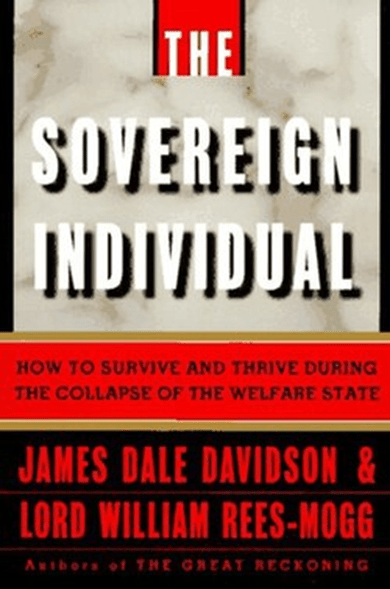
Particularly exciting – for Libertarians – is the change in the subtitle of this book. Originally published in 1997 by Simon & Schuster Inc., the subtitle was “How to survive and thrive during the collapse of the Welfare State.”
In 1999 however, the book was reprinted and given a new subtitle: “Mastering the Transition to the Information Age”.
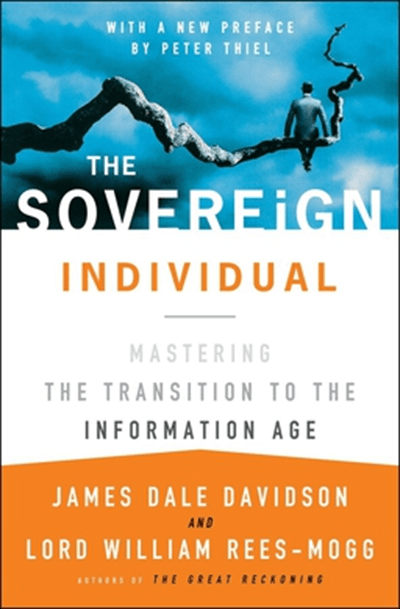
You don’t have to be a conspiracy theorist to speculate about the reason for this change. The publisher likely found the attack on the social-democratic welfare state a bit too provocative. While the social-democratic ideal, the welfare state, still seems sacrosanct, we’re seeing the term “welfare state” slowly disappear from public vocabulary. So why rub salt on the wound? The concept of the welfare state seems to have been replaced by the concept of the rule of law. The (democratic?) rule of law is something completely different from the social-democratic welfare state. While a libertarian can still legitimately claim to oppose the democratic welfare state, it’s somewhat more problematic if you speak out wholeheartedly against the rule of law. You’re then quickly considered a criminal.
A transition to a repressive form of government?
You will find a very interesting prediction in the book about the transition from the welfare state to a repressive form of government based on legalistic principles: “Lacking their usual scope to tax and inflate, governments, even in traditionally civil countries, will turn nasty. As income tax becomes uncollectable, older and more arbitrary methods of exaction will resurface. The ultimate form of withholding tax—de facto or even overt hostage-taking—will be introduced by governments desperate to prevent wealth from escaping beyond their reach. Unlucky individuals will find themselves singled out and held to ransom in an almost medieval fashion. Businesses that offer services that facilitate the realization of autonomy by individuals will be subject to infiltration, sabotage, and disruption. Arbitrary forfeiture of property, already commonplace in the United States, where it occurs five thousand times a week, will become even more pervasive. Governments will violate human rights, censor the free flow of information, sabotage useful technologies, and worse.” (Translation: “Deprived of their usual means of taxing and collecting, governments, even in traditionally civilized countries, will become dirty. As income taxes become uncollectible, older and more arbitrary methods of collection will reappear. The ultimate form of withholding taxation—de facto or even open hostage-taking—will be implemented by governments desperate to prevent wealth from slipping beyond their grasp. Unlucky individuals will be singled out and held hostage in an almost medieval manner. Businesses offering services that facilitate individual autonomy will be subject to infiltration, sabotage, and disruption. Arbitrary asset confiscation, already commonplace in the United States, where it occurs five thousand times a week, will become even more widespread. Governments will violate human rights, censor the free flow of information, sabotage useful technologies, and worse.”) You could say it’s out of the frying pan into the fire. We don’t consider hostage-taking, punishment before a legally valid conviction, to be constitutional, but it has now become a reality.
Disgusting
The dystopia of a government going to extremes of injustice is not fortune-telling, but the prediction is gradually coming true. Last week (June 10, 2025), the Minister of Justice and Security and Bilderberg participant David van Weel (VVD) proudly tweeted:

English translation:
“Cash payments over 3.000 Euro for goods will be forbidden. And from November 2026 on, we can, thanks to EU-regulation, confiscate criminal assets even without a conviction. Thus we hit criminals where it hurts: at their money.”
“Confiscating criminal assets even without a conviction“: that’s exactly the same as “arbitrary forfeiture of property.” That’s as disgusting as Health minister Hugo de Jonge’s statement about the unvaccinated people: “We know where they live.” Those Ministers have lost their moral compass. Apparently, the democratic rule of law no longer exists in the Netherlands. The liberal finance minister is essentially saying that if government evasion is labeled as criminal ideology, my assets can simply be confiscated without a presumption of innocence, without a judge being involved. Let alone that I would declare myself sovereign or audibly express the suspicion that judges are also biased toward the government! Imagine if I resisted arrest! Criminal. Money lost, house lost, car lost. Everything confiscated. That’s too much power for the hunters.
The somewhat self-satisfied government statement also states:
“In the coming years, the Public Prosecution Service wants to seize more assets.”
This is the PURPOSE of the Public Prosecution Service. The Public Prosecution Service, in collaboration with the IR (FIOD) bloodhounds, will hunt down suspected criminals head-on, waiting like panting puppies for their reward: the heart of the criminalized. New laws seem to be designed to generate more criminals: restrictions on cash payments, combating “disinformation,” and criminalizing dissidents. Supporting this, NCTV reports are being issued that identify threats to the rule of law: people who declare themselves sovereign. This explains why four Frisian “sovereigns” were arrested on June 11th…
Another “incident”: at the end of 2024, eight “radical sovereigns” were arrested on suspicion by the Public Prosecution Service of participating in a terrorist organization. Journalist Erik van de Beek extensively covered this in his article “Hunting Sovereigns” in De Andere Krant on January 19, 2025.
How can the Libertarian Party counteract this?
We can counteract this by spreading our libertarian ideology. We advocate for a drastic reduction in the power of the government apparatus and its influence on society.
Rather than a threat to an established order, we view “sovereignty” as a process of emancipation, of the citizen’s emancipation from the state. In libertarianism, there are no laws that prohibit living without a government. The government may not make it impossible for people to live independently. In a libertarian society, there is absolutely nothing wrong with living out your sovereign ideology. Everyone has their own way. We have long advocated for an individual right to opt out of majority decisions.
Do we then elevate ourselves above the law? No, but we do elevate our principles. Rational moral principles truly do stand above the law of the Kingdom of the Netherlands. John Locke already believed that laws are always subordinate to Reason. Few will disagree with Locke on this point, because laws and governments are, in principle, designed to protect freedom. If it is the government that goes against reason and takes away freedoms, such as punishment before conviction or the introduction of a maximum limit on cash payments, then resistance is called for. Not only because we experience this as a moral duty, but because we must protect our freedom ourselves if the government no longer does so. We can then replace that government with something that fulfills its task better. We can do this, among other things, through political channels. There is, therefore, a very good reason to maintain a libertarian political party. Again, the libertarian principles are:
Mutual respect for (self-)ownership and the Non-Aggression Principle.
It is a recipe for a lasting, peaceful society. If the exponents of an unreasonable and exploitative government now seek to challenge these principles, they will pick a fight with the emancipating citizen and generate resistance themselves. They can never win that fight.
The rise of the sovereign individual.
Davidson and Rees-Mogg state: “The end of an era is often a period of intense corruption. With the loss of cohesion in the old system, social ethics disappear, creating a breeding ground for people in powerful positions to combine public goals with their own amoral activities” (p. 337).
According to the authors, it is precisely current technological developments that make it easier for citizens to escape the shackles of citizenship. The Netherlands is well on its way to becoming a fertile breeding ground for people achieving the transition to individual sovereignty: liberation from coercion, the constraints of unreasonable laws, and hostage-taking.
“The Information Revolution will liberate individuals as never before […] As human transactions increasingly occur in the parallel universe of the cybereconomy, and outside the confines of government regulation, the individual’s relationship to the state will be irrevocably altered.”
Government will never win this.

 IALP Newsletter
Leave a reply to EditorIALPnewsletter Cancel reply